
Free MOU Template Builder
Fill in Party A and Party B details, then complete each section. Use "Insert suggested text" to pre-fill a section with standard language you can edit. Empty sections are hidden in the PDF. Your Party A details are saved in your browser for next time.
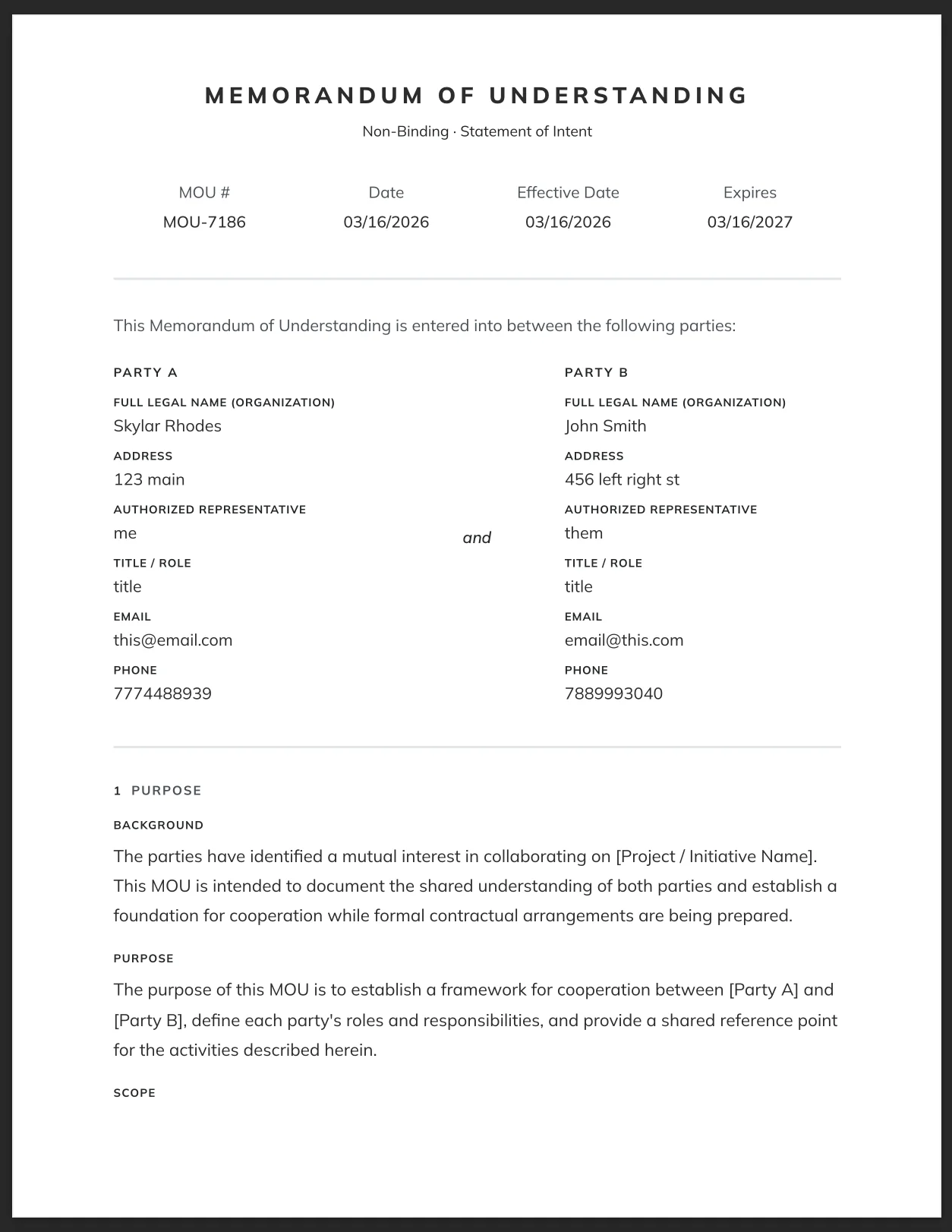
Memorandum of Understanding
This Memorandum of Understanding is entered into between the following parties:
IN WITNESS WHEREOF, the parties have indicated their agreement to this Memorandum of Understanding as of the date first written above.
What is a Memorandum of Understanding (MOU)?
A Memorandum of Understanding (MOU) is a non-binding written agreement between two or more parties that documents a shared understanding of intent, responsibilities, and terms before a formal contract is signed. It establishes a framework for cooperation without creating enforceable legal obligations.
MOUs are commonly used when parties want to formalize a working relationship or document agreed principles before committing to a full contract. Common use cases include:
- Enterprise software and services deals where implementation timelines are long and contracting takes time
- Partnership agreements between organizations with ongoing or evolving commercial relationships
- Government and institutional procurement where formal contracting processes are lengthy
- Multi-phase projects where early phases need to begin before final contract terms are agreed
- Academic and research collaborations formalizing shared goals and resource commitments
MOU vs contract: what is the difference?
The key distinction is binding force. A contract creates legally enforceable obligations: both parties are legally required to perform, and failure to do so is actionable. An MOU documents intent and mutual understanding without that enforceability. It says "we agree this is the plan" rather than "we are legally bound to execute it." Some MOUs include clauses that make specific provisions binding (such as confidentiality or exclusivity), so the line can blur depending on the language used.
What to include in an MOU
A well-structured MOU covers six areas. The template builder above includes all of them as editable fields.
1. Parties
Identify each party by full legal name, address, the name and title of the authorized representative, and contact information (email and phone). If the parties use short-form names throughout the document, define those names here.
2. Purpose
Provide background context on why the MOU exists, state the primary purpose, define the scope of cooperation, and list anything explicitly excluded. Separating background, purpose, scope, and exclusions makes the document cleaner and reduces ambiguity later.
3. Responsibilities
Allocate specific responsibilities to each party in parallel columns. This section prevents disputes by making clear which party is responsible for what. Be specific: generic language like "will cooperate" is less useful than "will provide X by Y date."
4. Financial Terms
If money is changing hands, describe the funding commitments or payment obligations clearly. If no funds will be exchanged, state that explicitly. Leaving this section blank is the most common source of confusion in MOU-related disputes.
5. Terms
Specify the effective date and duration, the conditions under which either party can terminate the MOU, and how much advance notice is required. MOUs without expiration dates tend to become stale; a defined term forces both parties to revisit and renew intentionally.
6. Legal
Cover confidentiality (how sensitive information must be handled and for how long), dispute resolution (good-faith negotiation or mediation before litigation), governing law, and a non-binding disclaimer. The disclaimer is especially important: it confirms the document is a statement of intent and does not create enforceable obligations unless specific provisions say otherwise.
MOU sample language and examples
Use these sample clauses as starting points. Edit the bracketed fields to match your situation.
Purpose clause
Scope of cooperation
Confidentiality clause
Termination clause
Non-binding disclaimer
How to create a quotation for an MOU
Many MOUs involve a commercial component: one party is pricing services or products for another before both are ready to sign a formal contract. An MOU quote is a formal pricing document that accompanies or is referenced by the MOU, documenting agreed or proposed pricing at the pre-contract stage.
How an MOU quote differs from a standard sales quote
A standard sales quotation is produced late in the deal cycle to confirm pricing and request customer acceptance. An MOU quote is produced earlier and typically carries a different status:
| Dimension | Standard Sales Quote | MOU Quote |
|---|---|---|
| Deal stage | Close to commitment | Pre-contract, intent stage |
| Pricing status | Finalized and agreed | Agreed in principle, subject to contract |
| Binding nature | Typically binding on acceptance | Typically indicative |
| Recipient action | Accept or decline | Review and countersign MOU |
| Version history | Usually one final version | May have multiple iterations |
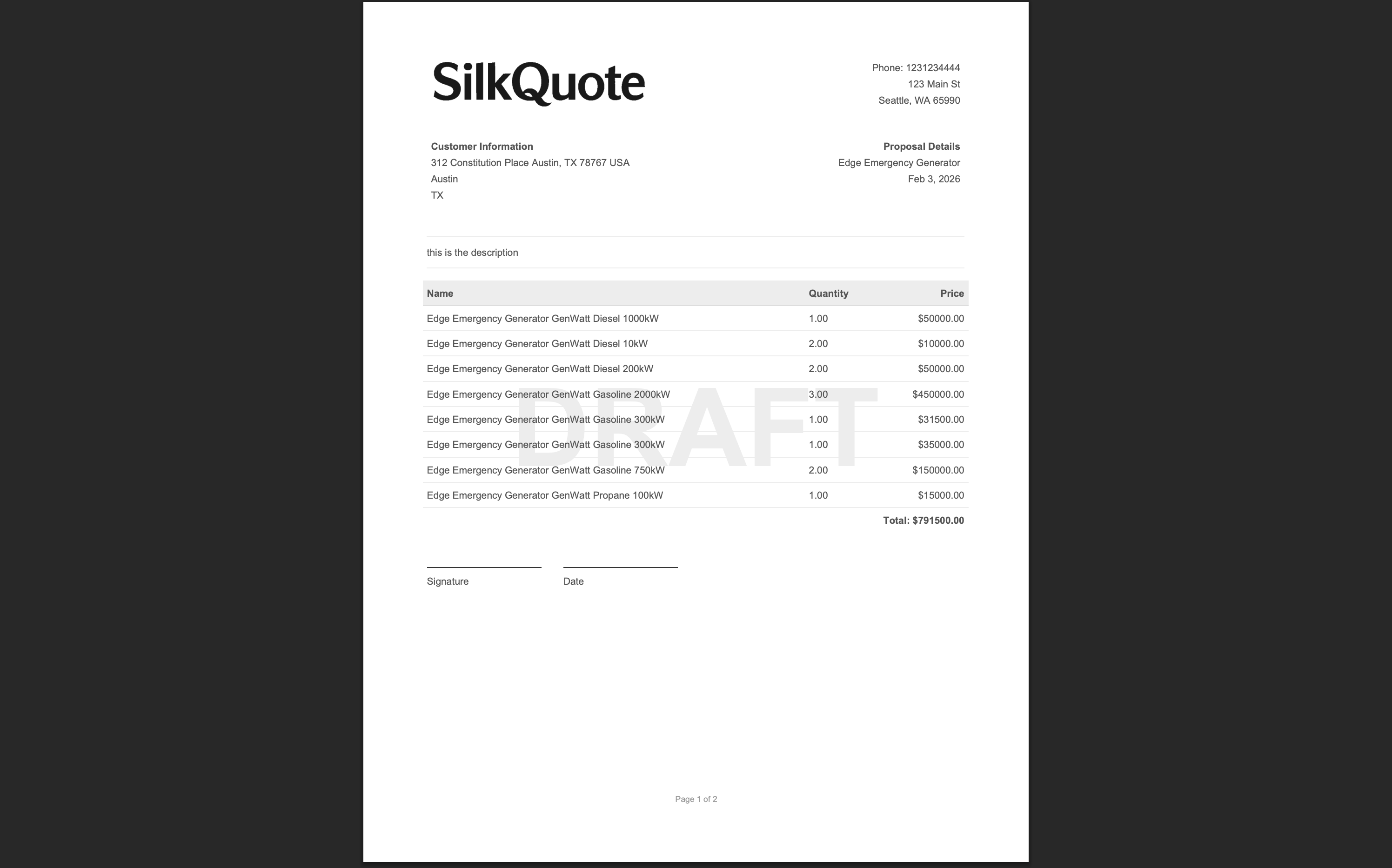
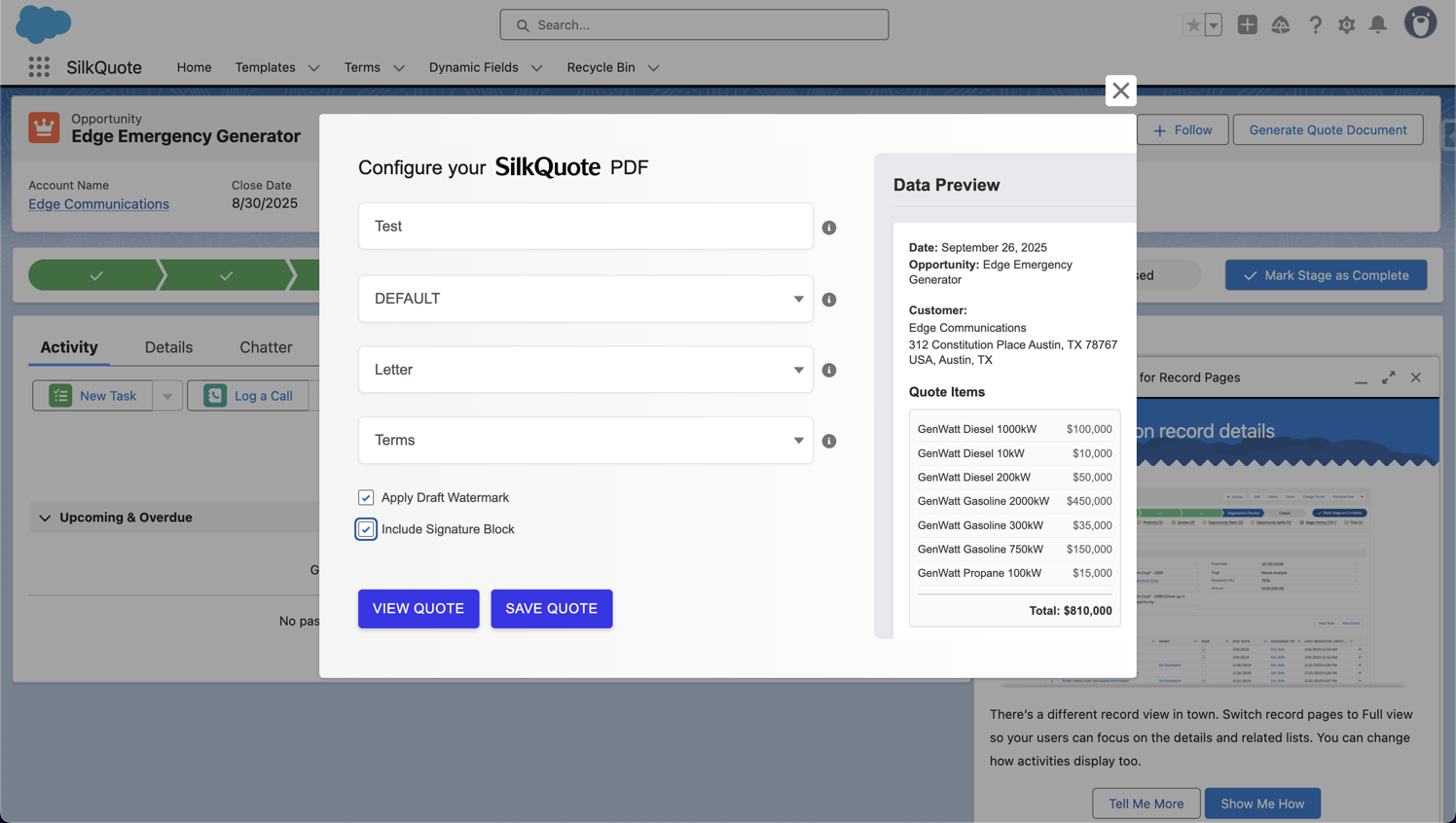
For one-off MOU quotes, use the free quotation generator to create a professional PDF quote with line items, tax, and payment terms in minutes. For Salesforce users managing MOU-stage deals in CRM, SilkQuote generates branded PDF quotations from Opportunity data automatically, with support for custom template sections like indicative pricing disclaimers and assumption blocks.
MOU vs MOA vs LOI vs NDA vs contract
These document types are often confused. Here is how they differ:
| Attribute | MOU | MOA | Letter of Intent | NDA | Contract |
|---|---|---|---|---|---|
| Binding? | Generally no | Can be binding | Generally no | Yes | Yes |
| Purpose | Documents shared intent and cooperation framework | Formalizes a specific agreement or commitment between parties | Expresses intent to enter a deal; outlines key terms | Protects confidential information exchanged between parties | Creates enforceable obligations for defined deliverables |
| Typical use | Partnerships, pre-contract stage, govt programs | Grant agreements, interagency programs | M&A, commercial deals, real estate | Any information-sharing relationship | Service delivery, procurement, employment |
| Signed by | Authorized representatives of each party | Authorized representatives | Typically senior deal principals | Authorized representatives | Authorized representatives |
| Leads to | Formal contract or MOA | Program execution or formal contract | Definitive agreement or contract | Stands alone or precedes a broader agreement | Performance, delivery, payment |
Note: the legal status of any document depends on its specific language and the jurisdiction. When in doubt, have legal counsel review the document to confirm whether it creates binding obligations.
Frequently asked questions
An MOU (Memorandum of Understanding) is a written document that formalizes a shared understanding between two or more parties before a formal contract is signed. It describes the purpose of the relationship, each party's responsibilities, and the scope of cooperation, without creating legally enforceable obligations.
In most cases, no. An MOU is a statement of intent, not a contract. However, specific provisions within an MOU, such as a confidentiality clause, can be made binding if the language explicitly says so. The document as a whole is typically non-binding unless it meets the legal requirements for a contract.
A contract is legally enforceable: if one party fails to perform, the other can seek legal remedy. An MOU documents intent and a cooperative framework without that enforceability. Contracts are used once scope, pricing, and obligations are confirmed. MOUs are used earlier, when the parties want to formalize their shared direction while details are still being worked out.
An MOA (Memorandum of Agreement) is generally more specific and can be binding. Where an MOU documents intent, an MOA often documents an actual agreement on specific terms. MOAs are common in government and grant contexts. The line between MOU and MOA varies by jurisdiction.
A well-structured MOU includes: the full legal names, addresses, and representative contact information for both parties; a purpose section covering background, scope, and exclusions; each party's roles and responsibilities; financial terms (or a statement that no funds are exchanged); terms covering duration, termination, and notice period; and legal provisions covering confidentiality, dispute resolution, governing law, and a non-binding disclaimer.
Use the free MOU template builder at the top of this page. Fill in your organization's details, the other party's information, and each section (purpose, scope, responsibilities, timeline, confidentiality, termination, governing law). Click 'Download / Print PDF' to save the document. No account or software is required.
An MOU quote is a formal pricing document attached to or referenced by a Memorandum of Understanding. It documents the agreed or proposed pricing, scope, and commercial terms at the pre-contract stage of a deal, before a binding agreement is executed. MOU quotes are typically marked as indicative, meaning the pricing is agreed in principle but subject to final contract execution.
This depends on the language in both documents. Most MOUs are non-binding, and a quotation referenced in an MOU is typically indicative unless both parties explicitly agree in writing that the pricing terms are binding. Always have legal counsel review the MOU and associated quotation if there is any question about binding intent.
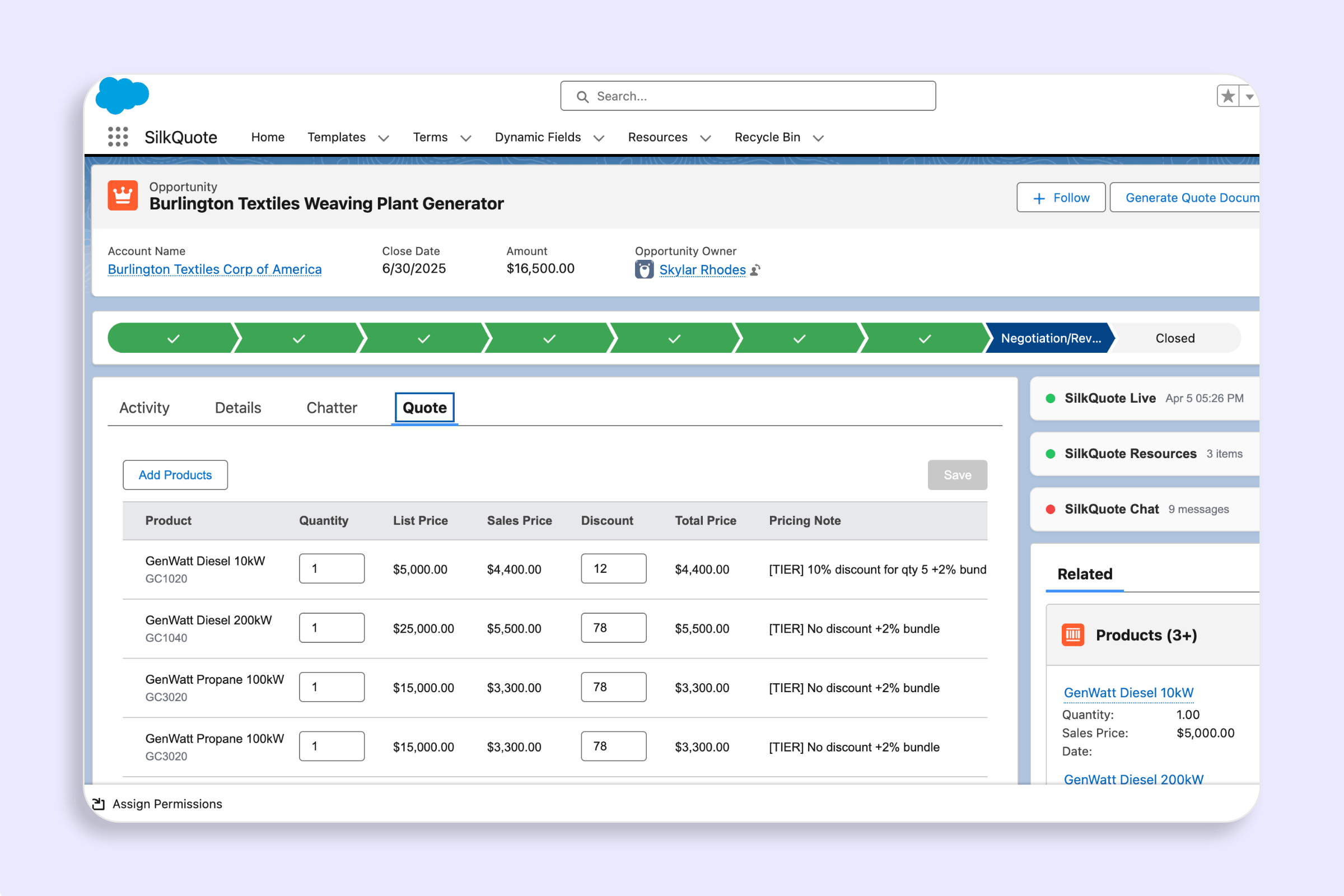
Yes. SilkQuote generates branded PDF quotations from Salesforce Opportunity data. For MOU-stage deals, you can create an Opportunity with the proposed scope and pricing as line items, add MOU-specific terms sections in the quote template, and generate a formal PDF in seconds.
Quoting an MOU deal from Salesforce? Skip the typing entirely.
SilkQuote pulls your Salesforce account info, products, and pricing into a branded PDF quote automatically, with no copy-pasting or data entry. Add MOU-specific sections like indicative pricing disclaimers and assumption blocks to your template, then generate a polished document in one click.
SilkQuote is free. Salesforce offers a free plan for up to 2 users. No credit card required.