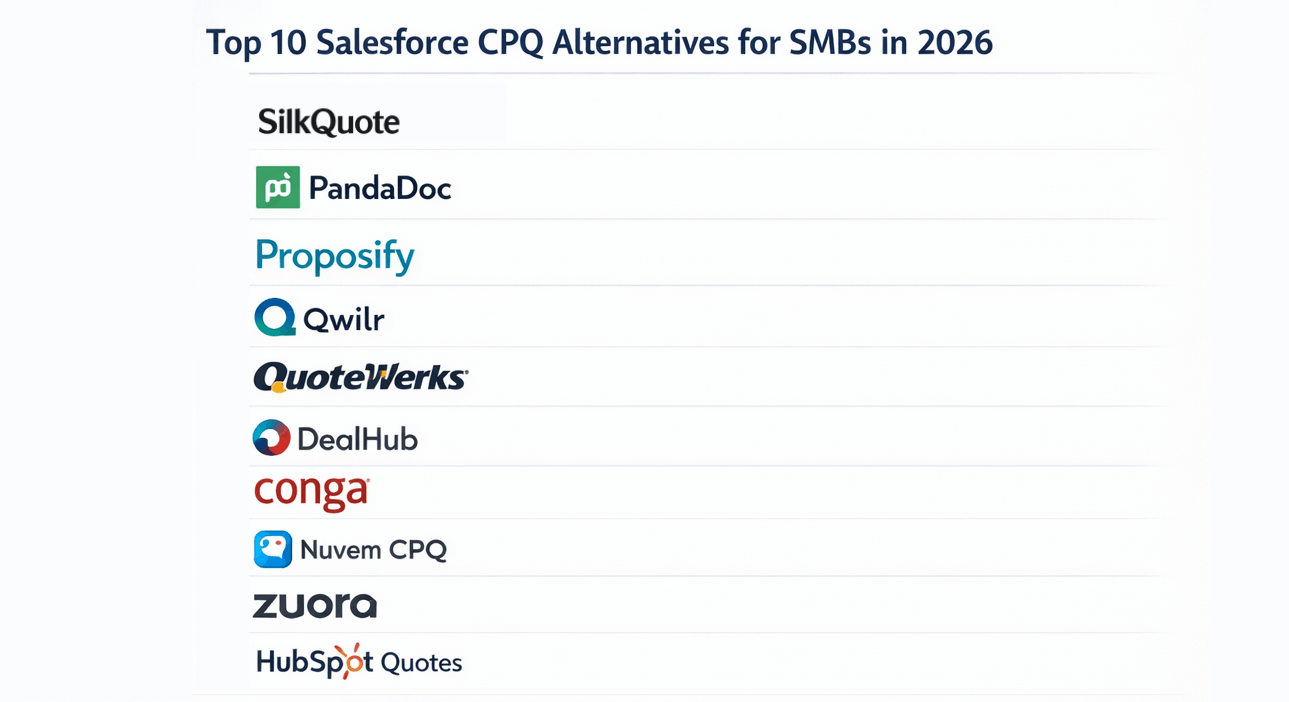
Salesforce CPQ entered End of Sale in March 2025. No new customers can purchase it. Innovation has stopped. The product team’s resources have shifted to Revenue Cloud Advanced. For the more than 6,000 organizations that rely on CPQ today, the question is no longer whether to plan a transition. It is when and to what.
This page covers what the Salesforce CPQ end of sale actually means, what your three options are, and how to evaluate whether you need another full CPQ or whether a focused quoting tool covers your real requirements. If you are searching for a free Salesforce CPQ alternative, the answer depends significantly on what you were using CPQ for.
What Happened to Salesforce CPQ
Salesforce confirmed the CPQ end of sale in March 2025. The announcement was not a surprise. Salesforce had been positioning Revenue Cloud as the successor for several years prior. But the formal End of Sale marks a turning point that accelerates the CPQ sunset timeline for customers who had been waiting for clearer direction.
End of Sale vs. End of Life. End of Sale means no new customers. Existing CPQ licensees keep their access, continue to receive critical security patches, and will not lose access overnight. End of Life is the point at which the product is decommissioned entirely. No official date has been announced, but based on standard Salesforce product lifecycle patterns, most estimates place it in the 2029-2030 range.
What happens between now and End of Life. Even before End of Life, organizations on legacy CPQ will experience a declining environment. The partner ecosystem (consultants, implementation firms, documentation resources) is already moving toward Revenue Cloud and emerging alternatives. Bug fixes continue for critical issues, but new capabilities are not coming. New Salesforce platform features are validated against Revenue Cloud, not CPQ. Technical debt accumulates with each passing year.
For a detailed feature-by-feature analysis of what SilkQuote covers relative to legacy CPQ, see the Salesforce CPQ alternative guide.
Your Three Options
Organizations evaluating their path forward following the Salesforce CPQ end of sale have three realistic choices.
Option 1: Stay on legacy CPQ. This is defensible short-term for organizations mid-implementation or with heavy CPQ dependencies that make migration expensive. But staying long-term means accepting declining support, no new features, a shrinking partner ecosystem, and increasing risk as End of Life approaches. For most organizations, staying is a delay, not a strategy.
Option 2: Migrate to Revenue Cloud Advanced. Revenue Cloud is Salesforce’s stated CPQ replacement and the direction the platform is moving. If your organization needs full configure-price-quote capability (guided selling, complex pricing rules, subscription management) Revenue Cloud is eventually the right destination. But this is a full reimplementation, not an upgrade. Teams that have completed the migration report 12 to 24 month timelines and total project costs ranging from $100,000 to over $500,000 for mid-size implementations. At approximately $200 per user per month, the ongoing licensing cost is also significantly higher. For organizations with genuine pricing complexity, this may be the right path. For everyone else, it is a lot of cost and time solving a problem that does not require it.
Option 3: Right-size to a quoting tool. If your organization never configured CPQ’s pricing engine, never used guided selling, and primarily used CPQ to generate professional quote PDFs from Opportunity data, you do not need a CPQ replacement. You need a quoting tool. SilkQuote is free, Salesforce-native, and installs in hours. This is the right path for a significant portion of CPQ customers who were using an expensive enterprise tool to solve a problem that a focused quoting product handles completely.
Most Teams Used CPQ for Quoting, Not Configuring or Pricing
The honest assessment of how most CPQ customers used the product is that they bought a pricing engine they never configured and a product configurator they did not need. What they used day to day was quote PDF generation, template management, approval routing for discounts, and branded proposals sent to prospects.
This is not a niche use case. It is the majority use case among small and mid-market CPQ customers. The sales rep picking from a standard pricebook, adding line items to an Opportunity, and needing to send a professional-looking PDF does not require a pricing engine or a product configurator. It requires a document generation tool with template controls.
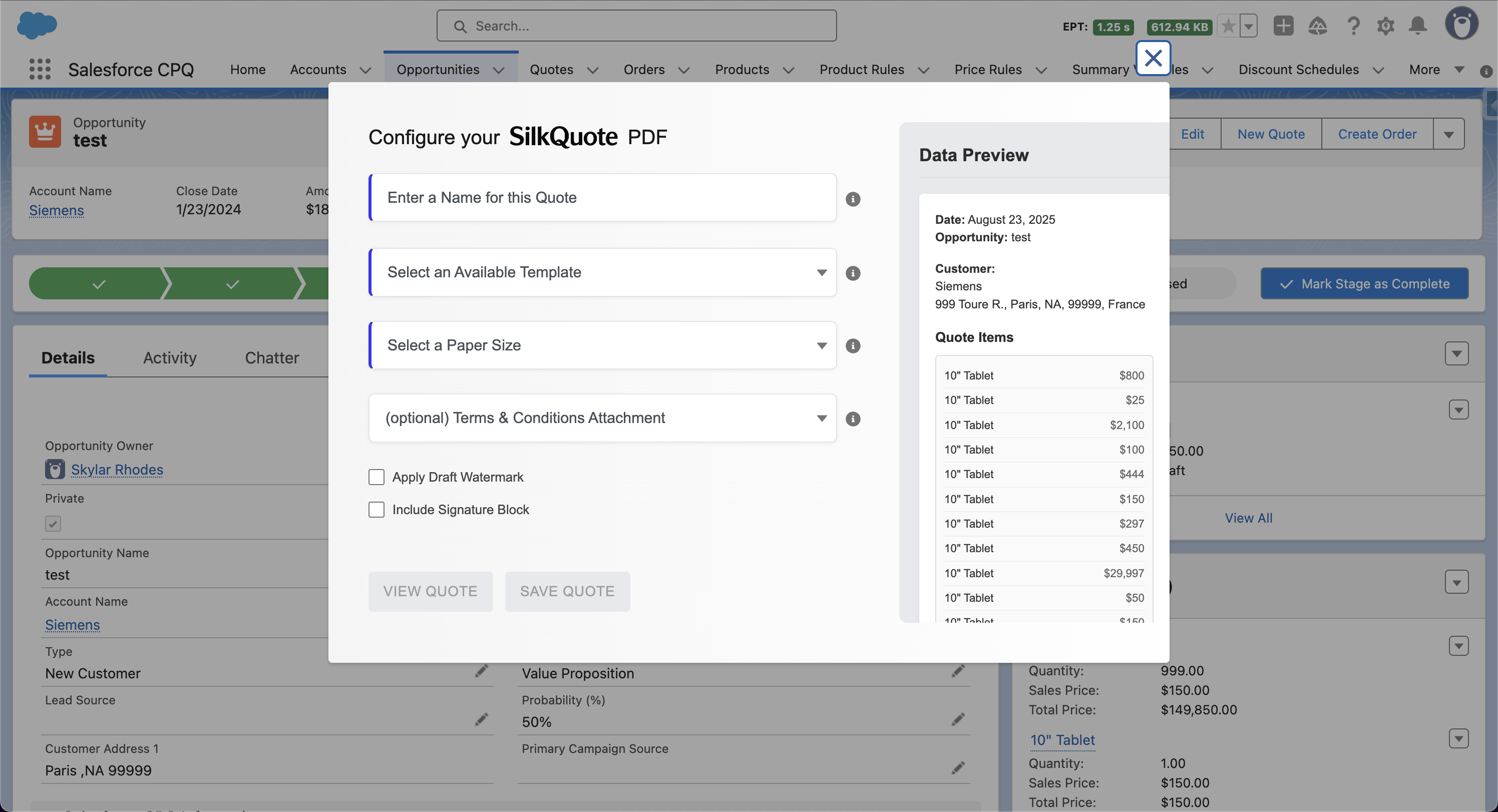
SilkQuote covers this entirely at zero cost: template design with conditional sections, field mapping from Opportunity and Account records, line item grouping with subtotals, branded PDFs, hosted quote links, prospect acceptance, version history, and activity logging. Every feature included, free, installed in hours. For teams looking for a Salesforce CPQ replacement that covers the quoting workflow without the rest of CPQ’s complexity, this is the right fit.
The growing search interest in “salesforce cpq alternative free” reflects exactly this realization. Organizations want what CPQ’s quoting layer gave them, without CPQ’s cost and complexity. And for teams evaluating their options in 2026, a free alternative that covers the actual use case is a more pragmatic answer than a full reimplementation.
Side-by-Side Comparison
| Salesforce CPQ (legacy) | Revenue Cloud Advanced | SilkQuote | |
|---|---|---|---|
| Status | End of Sale, no innovation | New, still maturing | Active development |
| Cost | ~$75/user/month | ~$200/user/month | Free |
| Implementation | Months + specialist | 12-24 months, full rebuild | Hours, any admin |
| Salesforce editions | Enterprise+ | Enterprise+ | Professional+ |
| Quote PDF generation | Yes | Yes | Yes |
| Hosted quote acceptance | Requires add-on | Requires configuration | Built in |
| Product configurator | Yes | Yes | No (use standard pricebooks) |
| Pricing engine | Yes | Yes | No (not needed for most teams) |
| Conditional logic | Yes (complex rules engine) | Yes (complex rules engine) | Yes (field-based, no code) |
| Active development | No | Yes | Yes |
| Support trajectory | Declining | Growing | Growing |
How to Evaluate What You Actually Need
The decision between a full CPQ replacement and a quoting tool comes down to an honest audit of your actual CPQ usage. Most organizations find the answer quickly when they ask the right questions.
If your reps pick products from a standard pricebook and pricing does not require multi-dimensional rules: you need quoting, not CPQ. Opportunity Products handles the pricing. SilkQuote handles the document.
If you do not use guided selling or product bundles with compatibility rules: you need quoting, not CPQ. Guided selling and product configuration are CPQ’s defining features. If they are not in your workflow, you have been using a sophisticated pricing engine as an expensive PDF generator.
If your quotes typically contain fewer than 20 line items with no complex pricing tiers: you need quoting, not CPQ. The pricing engine is built for scale and complexity that most SMB and mid-market sales motions do not have.
If your audit confirms that quoting is the actual use case, a Salesforce CPQ alternative that is free of pricing-engine overhead is the right direction. SilkQuote covers the full quoting workflow and is up and running in under an hour.
For teams evaluating their transition specifically for 2026 planning, the Salesforce CPQ sunset guide for small teams covers the practical transition questions in more detail. For a broad look at Salesforce quoting options and template design, see Salesforce quote templates and SilkQuote features.
Move Forward Without the CPQ Overhead
SilkQuote gives you professional quote generation, template design, prospect acceptance, and activity logging natively in Salesforce, at no cost. No pricing engine to configure. No guided selling rules to maintain. No specialist required. Any admin can set it up in an afternoon.
Install SilkQuote from the AppExchange and be generating professional quotes before end of day.
Frequently Asked Questions
What does Salesforce CPQ End of Sale mean?
End of Sale means Salesforce stopped selling CPQ as a new product in March 2025. Existing customers with CPQ licenses continue to have access, and the product continues to receive critical security patches. However, no new organizations can purchase CPQ, and Salesforce has shifted its R&D investment to Revenue Cloud Advanced. End of Sale is distinct from End of Life: the product will continue to function, but innovation has stopped.
When is Salesforce CPQ End of Life?
Salesforce has not announced an official End of Life date for CPQ. Based on standard product lifecycle patterns following End of Sale, most estimates place it in the 2029-2030 timeframe. Organizations with CPQ should monitor Salesforce communications and plan a transition before End of Life rather than waiting for a forced migration.
What does Revenue Cloud Advanced cost compared to CPQ?
Revenue Cloud Advanced is typically priced at approximately $200 per user per month, compared to approximately $75 per user per month for CPQ. Beyond licensing, migrating to Revenue Cloud requires a full reimplementation, not an upgrade from CPQ. Implementation projects commonly run $100,000 to $500,000 or more in services.
Does SilkQuote replace all of Salesforce CPQ's functionality?
No. SilkQuote replaces the document generation, template design, and prospect sharing components of CPQ, which are the parts most teams use day-to-day. It does not replace CPQ's pricing engine, product configurator, guided selling, or subscription management features. For teams whose primary CPQ use was generating professional quote PDFs, SilkQuote is a complete replacement.
How quickly can a team transition from CPQ to SilkQuote?
Most teams are generating quotes with SilkQuote within the same day they install it. Installation takes a few minutes. Building a complete quote template in the Configuration Manager takes a few hours. Historical CPQ-generated PDFs stored as Salesforce Content Documents are unaffected and remain accessible on their Opportunity records.